Saturday, February 28, 2026 – 2pm
St. John Episcopal Church at Oregon Episcopal School
6300 SW Nicol Road, Portland OR 97223
Recital followed by Hands-On Time for Newcomers!
Online Video Premiere – Saturday, March 14, 2026
WEKA YouTube Channel | Printable Program
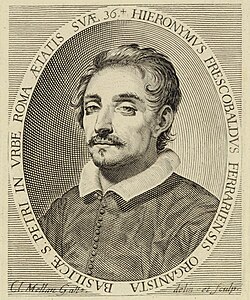
Girolamo Frescobaldi is a major figure in the history of keyboard music with a widespread and lasting influence on his contemporaries and later generations. This recital of 17th century music explores the colorful, expressive style of Frescobaldi and its echoes in the works ofJohann Jakob Froberger, Louis Couperin, and Michelangelo Rossi.
Recital Review by Carol lei Breckenridge
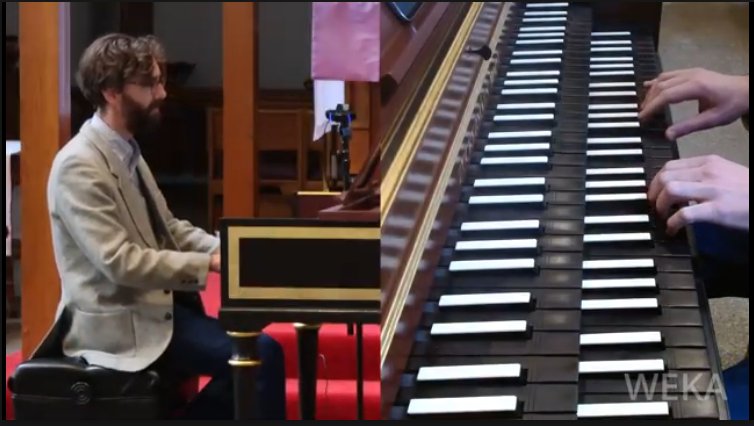
Wesley Leffingwell’s recital for WEKA, titled “Echoes of Frescobaldi,” displayed a thorough understanding and command of four early to mid-17th century composers, illustrating the influence throughout Europe of Girolamo Frescobaldi, music which – as Leffingwell stated – is uniquely idiomatic to the harpsichord. The performer also explained that the music’s effects were enhanced by meantone tuning, appropriate for Renaissance music. In this temperament, seven 3rds were pure, but others were quite dissonant; such contrasts were used by composers for special effects, such as after a section of agitated intervals, a serene cadence emerges with a pure 3rd. Throughout the program, Leffingwell’s playing powerfully brought out the dramatic contrasts inherent in this music.
The program began with the youngest of these composers, the decidedly French Louis Couperin (1626-1667), an auspicious choice, considering that the harpsichord used was a double manual French type. Built in the Zuckermann shop in 2006, and modeled on early 18th-century Blanchet and Taskin models, it has had extensive further voicing by Paul Irvin, including restringing with Stephen Birkett’s historical wire, and Irvin’s historically-based plectra voicing, resulting in a gorgeous, long-sustained tone; in the spirit of full disclosure, I am the fortunate owner of this instrument.
Leffingwell’s compilation of a Suite in F Major – taken from Couperin’s groupings of pieces in F Major (numberings from the Moroney Edition), began with an unmeasured Prelude (13). As usual, Couperin’s score consists entirely of whole notes, with implied phrasing indicated by long slurs. Leffingwell displayed absolute command and creativity of the phrasing within an improvisatory framework, driven by the harmonic structure. Occasionally and unexpectedly, rapid runs emerged, played with great flair.
The suite continued with a noble Allemande Grave (67), elegant Courante (69), more lively Courante (71), powerful Branle de Basque (73), sweetly intimate Sarabande (74), elegant Gigue (76), closing with a beautiful Chaconne (80). Leffingwell exploited the numerous registration possibilities of this harpsichord in the Chaconne’s contrasting couplets, ending in a grand manner.
Next on the program were three pieces by Johann Jokob Froberger (1616-1667). A native German, Froberger enjoyed an international career, including becoming court organist in Vienna and studying with Frescobaldi in Rome, as well as forays to London and Paris.
Froberger’s Toccata No. 2 in D Minor displayed a wonderfully improvisatory effect, as if it were being composed at the moment. Leffingwell superbly understands the myriad contrasts of this sectional piece, including reflective moments, sudden rapid runs, polyphonic vocal ensembles, and above all, chromaticism that stretched the ear’s expectations.
Froberger’s Suite in D Minor consisted of an elegant Allemande with just the right amount of time taken for expressive moments, a driving Courante, deeply felt Sarabande, and a Gigue exuding a serious nature combined with inner joy.
The final piece by Froberger, his Canzona No. 6, contained three contrasting sections: first, a vocal ensemble with striking chromaticism; next, a lively dance with spontaneous rapid runs; and closing with a section of driving, constant motion to the end.
Next appeared three compositions by Giromalo Frescobaldi (1583-1643) – the reputed original influencer of the rest of the program – beginning with his Toccata Settima, Libro I. Leffingwell masterfully captured a true improvisatory effect, in which near-constant contrasts and momentary excursions were displayed. This was followed by the more traditionally sectional Canzona Quarta, Libro 2.
Frescobaldi’s magnificent Partite 12 sopra l’Aria di Ruggiero, Libro 1, in which Leffingwell wonderfully portrayed the contrasting mood of each variation – from sweet to dancelike, to majestic –was a true highlight of the program, a composition that seemingly leads into a more Baroque approach with longer sections devoted to one Affekt.
Michelangelo Rossi (1602-1656), born in Genoa, spent most of his career in Rome; although a famed violinist, his surviving publication of 1657 consists of keyboard toccatas and correnti. For this program, Leffingwell chose the Toccata No. 7, famous for its final section’s extreme chromaticism, which seems to take one on a journey through the dark underworld. In meantone tuning, it is certainly grotesque and even frightening. Next, the Corrento No. 7 was played with a dancelike, lively quality, and welcome registration contrasts.
Finally, we were treated to Rossi’s Partita Romanesca, which Leffingwell performed with intense contrasts of mood. The last variation was played with spirited exuberance, and a final sweet “echo.”
Wesley Leffingwell, presently completing a DMA in Harpsichord at the University of Colorado, Boulder, is undoubtedly a young artist to keep our eye – and ear — upon. He possesses the rare trait of total involvement and command of the music at every moment; one has the impression that the music is “playing” him, as he responds to each expressive nuance. He certainly understands the intricacies of Italian-based Renaissance music. Bravo!
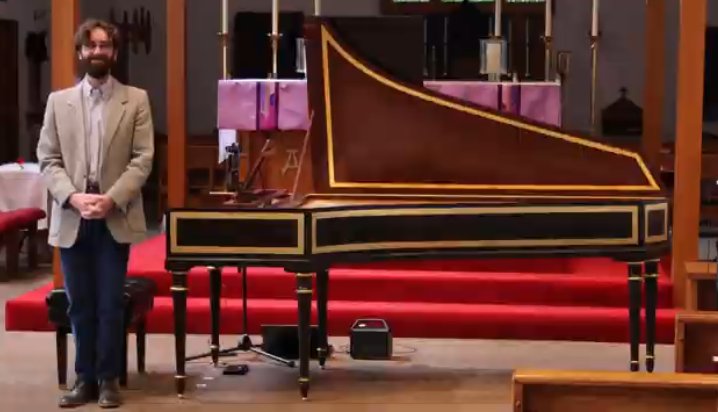
About the Performer
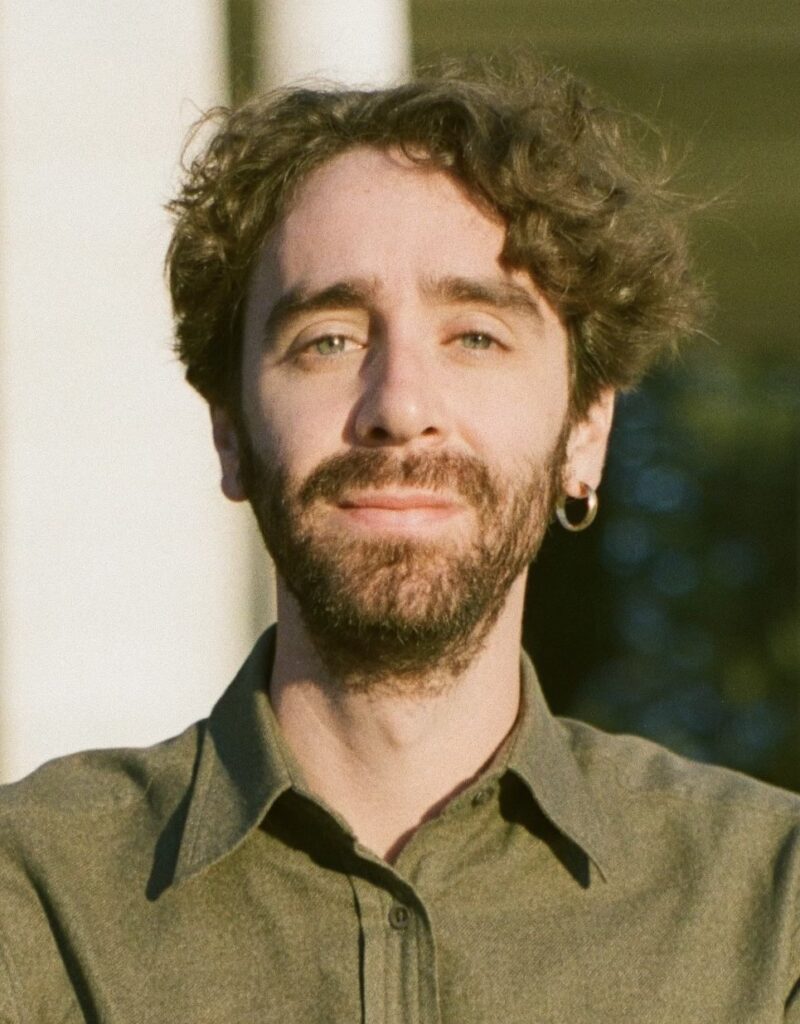
Wesley Leffingwell is a keyboardist based in Denver, Colorado. Recent performances have included appearances with the Colorado Symphony Orchestra, Greeley Philharmonic, Boulder Philharmonic, Breckenridge Music Festival, Bravo Vail, Ainomae Ensemble, Playground Ensemble, The Spirituals Project, Baroque Chamber Orchestra of Colorado, Boulder Bach Festival, Pro Musica Colorado, Colorado Bach Ensemble, Seicento Baroque Ensemble, and Cadmus. Wesley has held staff positions at the University of Denver and Regis University. He leads the choir as Music Director at St. Aidan’s Episcopal Church. In 2025 he attended the American Bach Soloists Summer Academy in San Francisco. Wesley is pursuing his DMA in Harpsichord at the University of Colorado, Boulder. Other recent performances include Opera Neo’s production of Handel’s Rodelinda, Baroque Chamber Orchestra of Colorado’s production of Hasse’s Marc’Antonio e Cleopatra, and a fortepiano recital at the regional Historical Keyboard Society of North America in Boulder.
Hands-on Time for Newcomers – Stay after the recital to try the harpsichord yourself! Piano teachers, piano students, newcomers, and enthusiasts are welcome to experience the feel of a harpsichord under the fingers. Knowing more about the instrument gives valuable insights about the Baroque style.
Admission
Free to WEKA members
Free to 18 and under, children accompanied by an adult
Free to college students with ID
General Admission $25 payable at the door