Saturday, March 2, 2024 – 2pm
Reed College, Portland – Performing Arts Building Room 320
Online Video Premiere – Saturday, March 16, 2024 – Recital Video | Talk Video
Printable Program
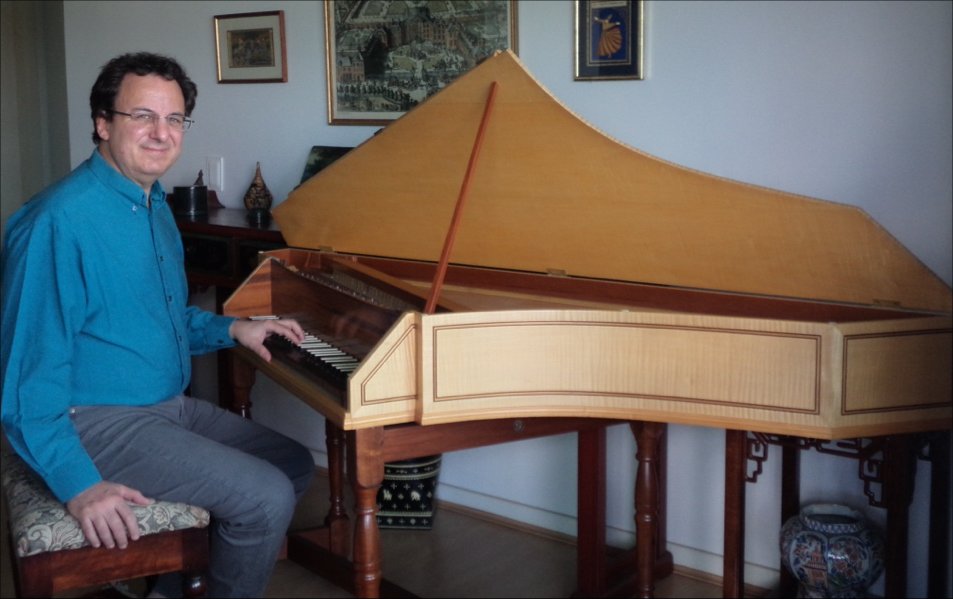
Douglas Amrine visits from Europe to perform music of the 17th century including virginalist composers of England and the Low Countries, followed by suites by Louis Couperin and Henry Purcell. After the recital, Douglas talks about his work to establish and maintain the Gustav Leonhardt Pedagogy Archive, a digital collection of primary-source material about Gustav Leonhardt’s teaching. The great influence of Gustav Leonhardt on the field of early music and keyboard playing is widely acknowledged. This is a special opportunity to learn about and discuss Leonhardt’s teaching with one who has knowledge of it.
Admission
Free to WEKA members
Free to 18 and under, and college students with ID
Children must be accompanied by an adult
General Admission $25 payable at the door with cash or check
The Gustav Leonhardt Pedagogy Archive:
A talk by its founder, Douglas Amrine
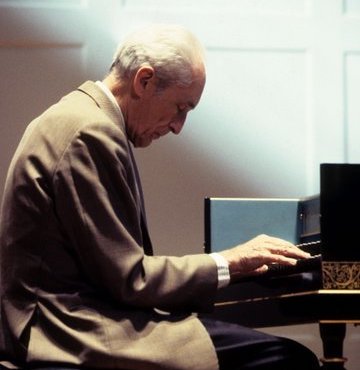
Gustav Leonhardt (1928-2012) began to explore the historical harpsichord and its repertory in the 1940s, when “early music” interested only a few isolated performers and musicologists. His search for the sounds of a forgotten musical world convinced only a few at first, then touched a widening public, and finally led him to international celebrity.
Over the course of 40 years, he welcomed some 150 harpsichord students (including dozens of Americans) into his Conservatory class in Amsterdam and gave numerous masterclasses and summer courses. Many of his students became important performers and teachers, who have shaped the historically informed performance (HIP) movement that flourishes worldwide. The Gustav Leonhardt Pedagogy Archive is a digital collection of primary-source material about Gustav Leonhardt’s teaching. Two dozen of his students, from the United States, the Netherlands, Germany, France, Italy, Korea and elsewhere, have provided detailed information about how they came to study with Leonhardt, what their lessons were like, and the lasting impact of Leonhardt’s teaching on their own work and teaching.
In this 45-minute talk, Douglas Amrine discusses why Leonhardt was such an important teacher, the key ideas he conveyed in his lessons, the impact of his teaching on the resurgence of interest in early music, his pedagogic approach, and how a team of three editors created the Archive.
“The core of musical pedagogy is, from my point of view, that musicians have to learn to formulate an answer when asked the question, ‘why?’” – Gustav Leonhardt in 2011
Recital Review
Douglas Amrine’s harpsichord recital and lecture on “The Leonhardt Legacy,” presented by WEKA on March 2, 2024, proved an inspiring event from several standpoints. All the repertoire came from the 17th century, which, as Amrine mentioned, is less commonly performed, and may be less readily accessible than 18th century music, as the emotions are less obvious and dramatic. However, he encouraged the audience to listen for moments of touching expression and the great panoply of effects mirroring the atmosphere of royal court entertainment. Especially admirable in Amrine’s performance were the steadiness of pulse throughout a piece, yet allowing for rhythmic flexibility and time for special moments, as well as a great variety of colors through register changes.
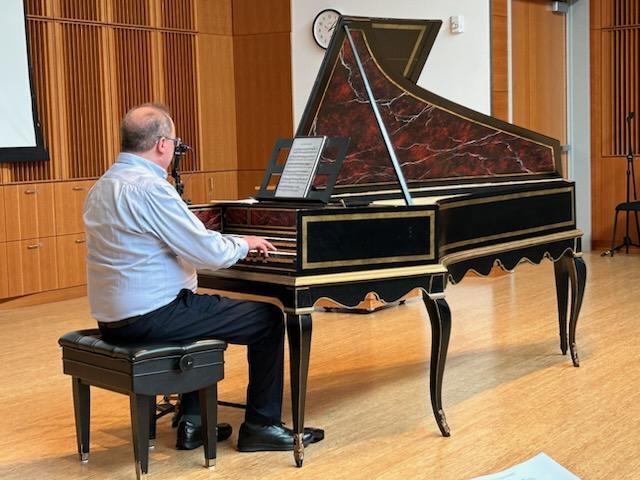
Varied Affekts were beautifully captured in Amrine’s masterful performance of several pieces by English virginalists (Martin Peerson, Robert Johnson, William Byrd, Orlando Gibbons, Thomas Tomkins, and Thomas Morley), including a wide variety of musical types – such as dance movements, fantasias, variations, and descriptive pieces (The Fall of the Leafe by Peerson and A Sad Pavan for These Distracted Times by Tomkins). According to the nature of the piece or phrase, Amrine created in turn touching simplicity and sweetness, or an incisive dancelike style. Especially beautiful was Tomkins’ A Sad Pavan, played on the front 8’ (upper manual), evoking a mournful quality; the relaxed tempo allowed one to savor its singing, sustained treble tones.
Interestingly, Amrine then played Purcell’s Suite in D Minor, in which the composer deliberately imitated French brisé (lute-like) style. As Amrine pointed out, since the English were not familiar with French style, Purcell precisely notated the staggered tones and notation. I’m sure it was a worthy endeavor, but to my ears, and probably inevitably, the result seemed a bit stilted and self-conscious. However, it was well and interestingly played. Amrine’s steady dance-like pulse for each movement, with flexibility as needed, provided the listener with a satisfying musical experience.
Before continuing, Amrine tuned the G-sharps to A-flats, since the harpsichord was in quarter-comma meantone, which brings out the pure 3rds that Renaissance composers prized. However, for instance, a pure E-G# produces a lower G# than the Ab of a pure Ab – C. Amrine then played music by Louis Couperin, beginning with his famous Tombeau de Mr Blancrocher, a lament for the great French lutenist after his death in 1652. The well-paced slow tempo allowed Couperin’s long-held harmonies to create a tragic effect.
The final work, Louis Couperin’s Suite in C Major, was a true highlight. Including two pièce croisée movements, in which the hands on two manuals cross each other within the same octave, they created — as Amrine described — an enchanting tonal effect of two different melodic instruments weaving around each other. The concluding Passacaille, with its hypnotic bass and powerfully ongoing pulse, bring us fully into the world of the French court.
The French style harpsichord used for this program, by Kenneth Bakeman, sounded absolutely superb. Paul Irvin, Reed College’s curator of the Early Keyboard Collection, has voiced the instrument to perfection; one can hardly even hear plucking, but rather, beautifully long-sustained singing tones that seem to emerge effortlessly, with a total clarity of pitch, and wonderful differentiation of registers. The treble tones’ sweetness took one’s breath away, and the bass was full yet clear, providing magisterial support. Douglas Amrine’s expressiveness, along with such beautiful harpsichord tone, made this a recital well worth hearing.
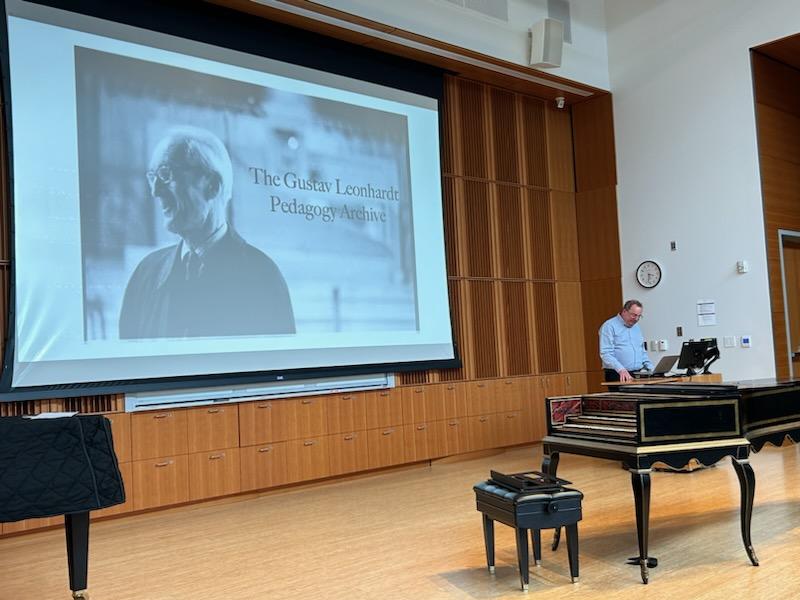
Following the recital, Douglas Amrine gave a highly interesting lecture about “The Leonhardt Legacy” and The Gustav Leonhardt Pedagogy Archive which he, Martha Cook, and Bruce Alan Brown founded in 2018. As Amrine stated, since Gustav Leonhardt (1928-2012) did not write down his thoughts, the archive is a key way to learn about his approach to harpsichord playing and teaching. Many key points were made, including these:
Leonhardt felt that live performance and a player’s connection to the audience were most important. He stated, “A recording represents music-making as poorly as a photograph represents an oil painting.” Rather, a performer should “captivate the audience with variety, imagination, fire and wit” and cause the audience to listen to each note. And, though he thoroughly studied historical treatises, and encouraged his students to do so, he stated: the performer must “bring to life the message of the composer” so “the score itself is our primary focus.”
His pedagogical approach was not dogmatic, but rather, he acknowledged that there is much the performer cannot know. Rather than insisting on his own interpretation, he encouraged students to discover their own artistic choices. Neither did he slavishly follow any particular rules, such as early fingerings.
Above all, Leonhardt emphasized the expression of a wide panoply of human emotions, conveying the composer’s “message,” and developing all the tools needed to convey them. Specific techniques he discussed were infinite gradations of articulation, and methods for creating nuanced dynamics, such as the effect of fading (the latter as through over-holding and staggered releases, etc.).
The Archive, which is an extremely interesting and valuable source of information that at present contains contributions from about 25 Leonhardt students, can be freely accessed online at: https://leonhardt-archive.com/
About Douglas Amrine – YouTube Channel
Harpsichordist and organist Douglas Amrine was born in Washington, D.C. in 1958. He attended Stanford University and Oberlin College, and did his post-graduate studies at the Sweelinck Conservatorium Amsterdam, where he studied both instruments with Gustav Leonhardt.
Douglas Amrine has given harpsichord and organ recitals in many European countries, as well as the United States, Singapore, India and Brazil. In 1982 he was a prizewinner at the Albert Schweitzer International Organ Competition. He has recorded two solo CDs of the harpsichord and organ music of J.S. Bach, as well as solo performances for Dutch and German radio. Amrine taught harpsichord at the Yong Siew Toh Conservatory in Singapore in 2011-2014.
To develop his understanding of early keyboard instrument performance, Douglas Amrine has travelled widely to play on historic instruments in private and public collections. Gustav Leonhardt invited him to give recitals on the Hagebeer-Duyschot organ of the Nieuwe Kerk, Amsterdam in 1982 and 1996. Amrine has also been invited by the Smithsonian Institution to perform on the 18th-century harpsichords by Dulcken and Stehlin.
Douglas Amrine has acquired copies of historic harpsichords by renowned makers such as Martin Skowroneck, Malcolm Rose, and Willem Kroesbergen. These fine instruments allow him to immerse himself in the soundworld of early keyboard instruments while at home in Amsterdam.
Press quotes
BBC Radio 3 ‘Record Review’, on Pro Cembalo Pleno: “Those who like their Bach bold and flamboyant will want this curio for their collection.”
L’Echo (Dreux, France): “[Amrine’s] virtuosic playing, always sensitive but powerful when necessary, is imbued with a deep delicacy, particularly perceptible in his way of realizing period ornamentation.”
The Straits Times (Singapore): “[Amrine] maintained a tight sense of continuity through a whole heap of varied escapades, and ended with some staggeringly florid passagework which was tossed off with deceptive ease . . . Harpsichords are not, by their nature, prone to dazzling displays of colour, but here we had a rich tapestry of sounds delivered with a robust musicianship.”
About The Reed College Early Keyboard Collection
Reed College is unique in the Portland area with an Early Keyboard Collection that can be shared, thanks to the efforts of Bonnie Garrett (fortepianist and harpsichordist), whose long career at Reed included both teaching and administration. Read about Bonnie Garrett on page 16 of the Reed College Magazine, Sep 2010