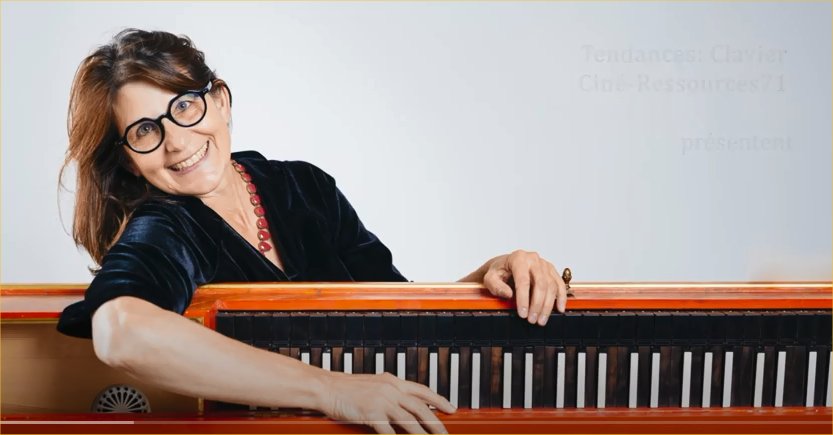
Saturday, April 20, 2024 – 2pm
Ascension Episcopal Parish – 1823 SW Spring St. Portland – Map
Online Video Premiere – Saturday, May 4, 2024 – Watch the Recital | Printable Program
Marcia Hadjimarkos, an Oregon native now in France, will be known to some of you from her time in the NW. She will share a wide range of English keyboard music at the clavichord, from a 1630 virginal book to the 20th century, including a sonata by Joseph Haydn. Marcia’s performances can be heard in these recordings and videos.
The lovely Ascension Episcopal Parish chapel has limited seating, in order to hear the instrument at its best. Please RSVP to weka@wekaweb.org to reserve your seat!
Admission – Those with reservations will be seated first
Free to WEKA members
Free to 18 and under, and college students with ID
Children must be accompanied by an adult
General Admission $25 payable at the door by cash/check only
Recital Review
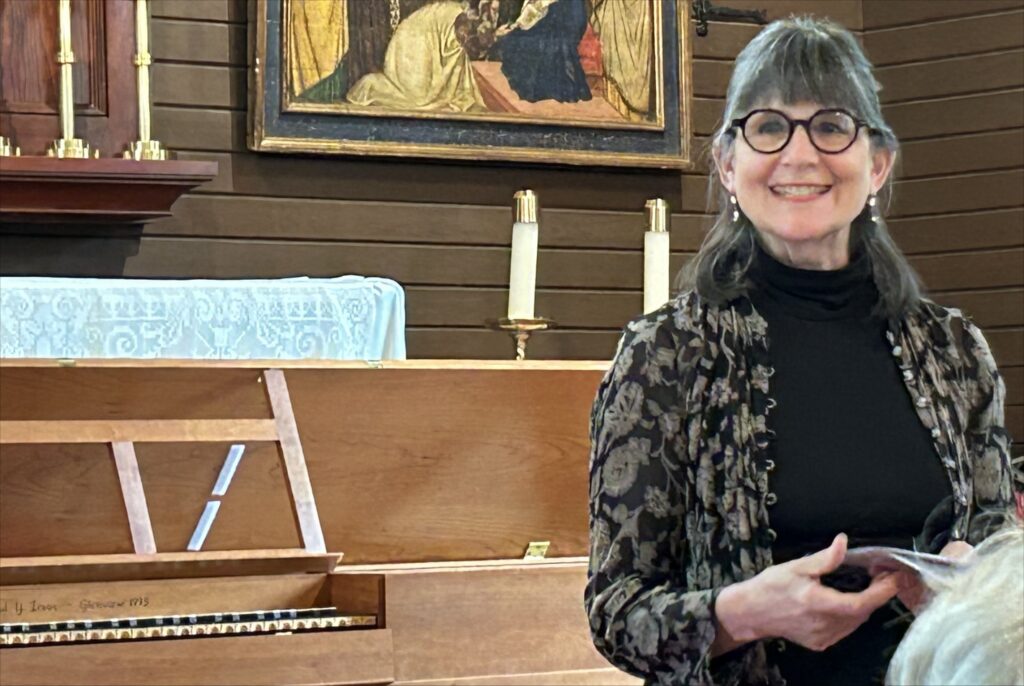
Ascension Episcopal Parish, in the hills of Southwestern Portland, provided a cozy and warm ambiance for Marcia Hadjimarkos’ clavichord program of English-based music on April 20, 2024. Far-ranging in chronology, from 17th-century English virginal music through contemporary music specifically written for clavichord, Hadjimarkos captivated the appreciative audience with her elegant style and expressive playing.
Six anonymous pieces from Priscilla Bunbury’s Virginal Book (c. 1630) opened the program: The White Ribbon; Put Up Your Dagger, Jamie; Mrs. Priscilla Bunbury hir Delight; Birch and Green Holly; George; and The Friend’s Good-Night. All the pieces featured homophonic texture – treble melody with a simple harmonic accompaniment. Most expressive were the sweet melody of Birch and Green Holly, George of lively temperament, and a contemplative Friend’s Good-Night.
Next appeared four compositions of (primarily) Classical style. Johann Christian Bach’s Sonata in E-flat Major, Op. 5, No. 4, written in London in 1766, exuded Mozartean flavor. Often referred to as “the London Bach,” Johann Christian was the 18th child of Johann Sebastian. After his father died in 1750, 14-year-old Christian finished his musical education with his older brother Carl Philipp Emanuel Bach in Berlin. Later, he spent several years in Italy, soaking up the popular Galant style. When he moved to London in 1762, his engaging compositions attracted eager audiences. He is said to have been the first to play a recital – in 1768 — on a square piano. The clavichord’s dynamic possibilities, then, provide an appropriate medium for his music.
J.C. Bach’s Sonata Op. 5, No. 4 certainly presents an entertaining Galant style, with its vocal melodies, simple chordal accompaniment, occasional lively runs, and contrasting dynamics. A two-movement composition, the Rondo projected a sweet innocence.
The succeeding two composers ga ve us a taste of early Romanticism, yet within the bounds of Classical structure. George Frederick Pinto’s (d. 1806) dramatic Rondo in E-flat Major featured fuller textures, along with greater harmonic and expressive contrasts. The couplets particularly unleashed some stormy and shocking moments, almost Schubertian in their drama.
Maria Hester Park’s (d. 1813) Sonata in F Major, Op. 4, No. 2, from 1790 was also fascinating in its dramatic contrasts. The two-movement work’s Minuetto had a sweet, sentimental effect. Hadjimarkos’ well-controlled closing decrescendo to a pp was especially beautiful.
Joseph Haydn’s Sonata in D Major, H. XVI:51, was written late in his life during one his trips to London (1794), where the style of piano playing and composition was more flamboyant than that of Vienna. We can certainly find many of these elements in this sonata, having fuller textures and virtuosic parallel 3rds/6ths, all well executed by Hadmijarmos. I also appreciated the elegance she brought to the entire 2-movement sonata. One usually hears Haydn’s keyboard works played on piano; however, given his lifelong association with clavichord, I enjoyed hearing this more intimate rendition, such as Haydn himself may have enjoyed in his own sitting room.
The final two compositions were by contemporary composers, and written specifically for the clavichord. Three pieces from Herbert Howells’ (d. 1983) Lambert’s Clavichord (1927), a collection inspired by his friendship with the harpsichord and clavichord builder Herbert Lambert of Bath, exploited subtle and contrasting dynamic qualities of the clavichord, as well as reminiscences of earlier virginal music. In Lambert’s Fireside, Hadjimarkos’ subtle dynamics well brought out the intimate and expressive nature of a glimmering fireside, while Sir Hugh’s Galliard offered up a spirited style under Hadjimarkos’ nimble fingers. Lastly, in De la Mare’s Pavane, interesting interplays of minor, major, and phyrygian modes, and a wide range of subtle and contrasting dynamics fully exploited the clavichord’s expressive capabilities.
Concluding the program, Graham Lynch’s (b. 1957) Petenara, Four Pieces for Clavichord, composed in 2005, ushered us into a fascinating tonal world in which traditional structures of harmony, meter, and form have been left behind, in favor of free improvisatory effects. Hadjimarkos excelled in these pieces: Bell (Bass String), with riveting long pauses and an ostinato bell tolling; The Six String’s ostinato and improvisatory phrases; Dance’s perpetual motion and whirlwind effect; and De Profundis’ three-note descending bass ostinato and spontaneously contrasting sections.
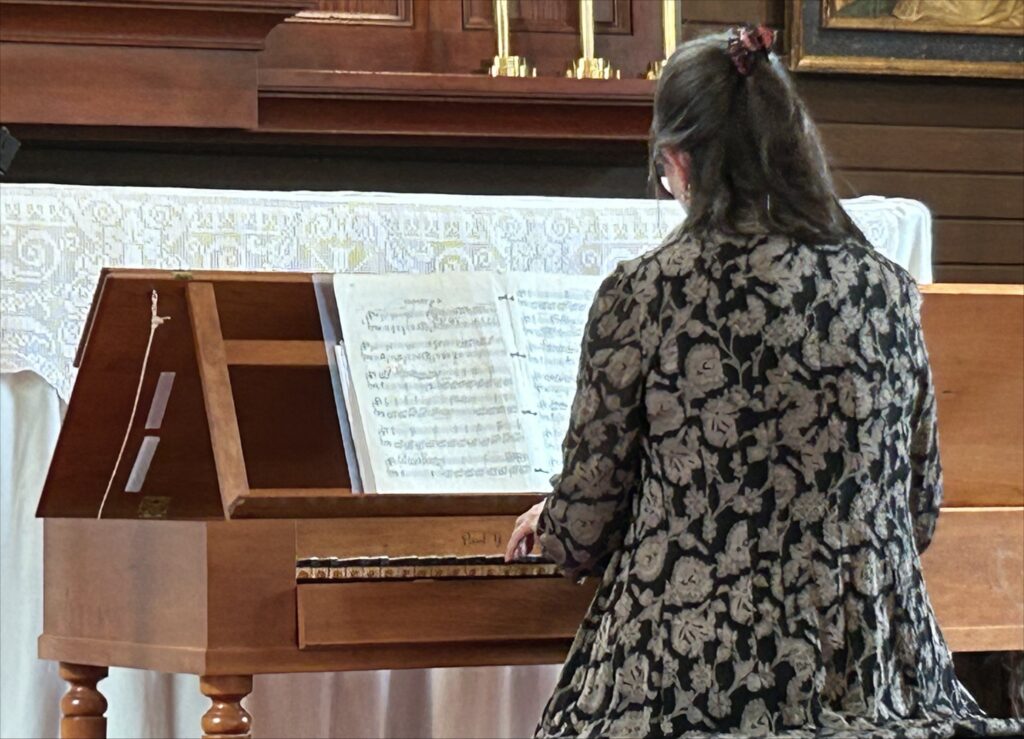
The clavichord used for this program was an unfretted 5-octave instrument after Christian Gottfried Friederici of 1765, built by Paul Irvin in 1995 for Carol lei Breckenridge. It has been strung in Stephen Birkett’s historical wire, and has had extensive adjustment and voicing over the years. It possesses a quite robust tone, long sustain, and superb clarity in all its ranges. Marcia Hadjimarkos’ well controlled and elegant playing elicited from the instrument tones that rang through the parish chapel and into our hearts.
Review by Carol lei Breckenridge
About Marcia Hadjimarkos – YouTube Channel
Marcia Hadjimarkos, performs, records, and teaches on a variety of keyboard instruments from the earliest Florentine piano to its modern counterpart, with particular interest in clavichords and historic pianos both grand and square. She is a Portland native, and began piano studies with Nellie Tholen. After earning degrees in piano performance and French from the University of Iowa, she studied fortepiano with Jos Van Immerseel at the Paris Conservatoire National Supérieur de Musique.
Career highlights include song recitals with Emma Kirkby, Beth Taylor, and Julianne Baird, the commemoration of Hélène de Montgeroult’s 250th anniversary at the Paris Conservatoire, a concert series on a facsimile of the Cristofori piano, a clavichord concert at the Institute for Advanced Study, an 8-recital performance of the complete Haydn sonatas on several early keyboards, and the premiere of a clavichord suite written for her by American composer John Harbison. Marcia also enjoys working with actors and singers to co-create programs that combine words and music, such as ‘The Intimate Mozart’ (based on the Mozart family letters) and ‘Entre Deux Feux’ (commemorating popular and art songs of the World War I era). She gives frequent master classes on historic pianos and clavichords in conservatories, museums, universities, and festivals.
Her performances are described as “imaginatively realized, full-blooded, and loving”, “brilliantly intelligent”, and “dynamic, free, and powerfully shaped”. She has played at the International Piano Festival in La Roque d’Anthéron, La Folle Journée de Nantes, the Sablé Festival, l’Arsenal de Metz, the Journées Musicales d’Automne, the National Music Museum, Rencontres Internationales Harmoniques, the Nordic Historical Keyboard Festival, the Cobbe, Finchcocks, Bad Krozingen, Fenton House and Russell Collections, the San Diego Early Music Society, MusicSources…Her recordings of Mozart Sonatas and Rondos, Haydn Sonatas, Character Pieces by C.P.E. Bach, Haydn songs & cantatas with Emma Kirkby, Viennese music with Hugo Reyne (czakan), and Schubert Dances and Sonata have been enthusiastically received, and have earned various awards including a Diapason d’Or. A recording of solo piano and the complete chamber works by Hélène de Montgeroult, played on an 1817 square piano, with mezzo-soprano Beth Taylor and violinist Nicolas Mazzoleni, was released in October 2023 on the Seulétoile label. The album Murmurations, released on the Outer Markerlabel and available on the NativeDSD site, was recorded on an 1889 New York Steinway B. It reflects Marcia’s return to more modern keyboard instruments and their repertoire,and includes works by Satie, Pärt, Cage, Monk, Glass, Mompou, Tailleferre, and Skempton.
One thought on “Old & New: Five Centuries of English Clavichord Music With Marcia Hadjimarkos – April 20, 2024”
Comments are closed.