A Mid-Week event of the 25th Annual William Byrd Festival
Wednesday, August 7, 2024 – 7:00pm
St. Michael & All Angels Church – 1704 NE 43rd Ave, Portland
Online Video Premiere – Saturday, August 24, 2024 – Recital Video
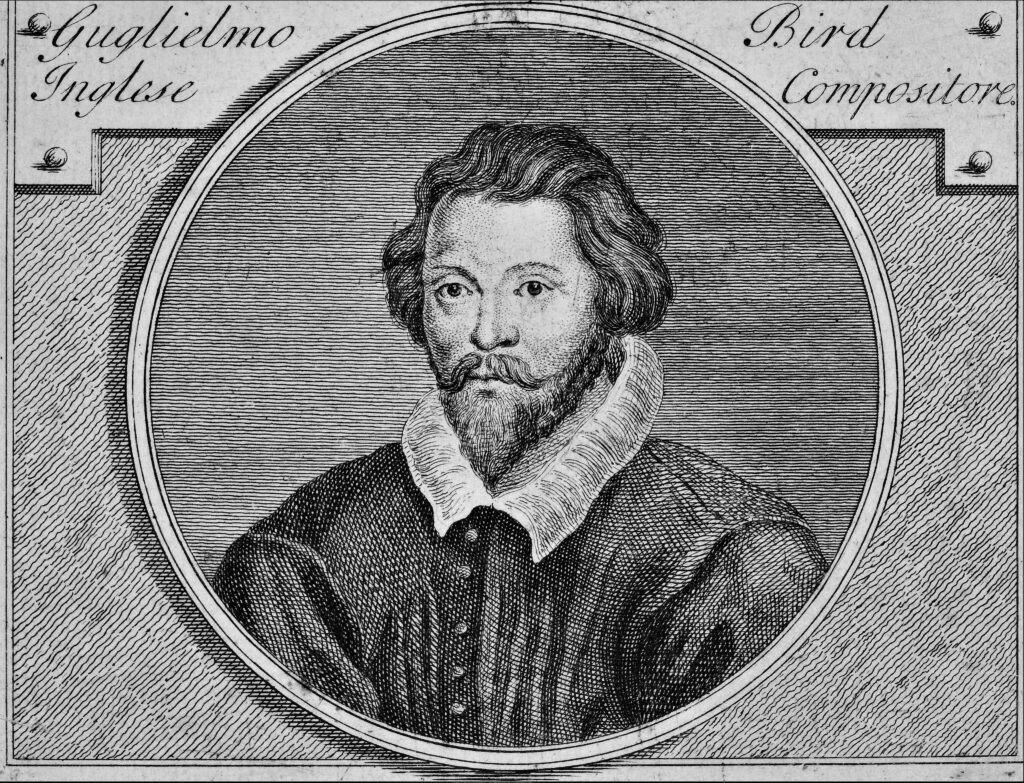
A contemporary ode to William Byrd reads: “None suche I feare shall rise that may be calde his sonne.” Besides his monumental choral output, William Byrd was also widely renowned in his time for his role in the development of a uniquely English style of keyboard music, one that was abandoned in the decades after his death.
Harpsichordist Eugene Petrushansky explores the music of Byrd, his immediate antecedents, his late 17th-century successors, and the 20th-century resurgence of interest in the old repertoire, including Orlando Gibbons, John Roberts, Herbert Howells and Lennox Berkeley.
Recital Review
Eugene Petrushansky’s recital on August 7, 2024, as part of the 25th Annual William Byrd Festival, provided a fascinating program of music not only by Byrd (c. 1540-1623) and other Renaissance composers, but also two 20th-century composers influenced by the earlier style. Petrushansky played with remarkable energy and flawless technique that had the audience practically cheering by the end. The lovely, warm acoustics of St. Michael and All Angels’ sanctuary added significantly to the enjoyment of a memorable program.
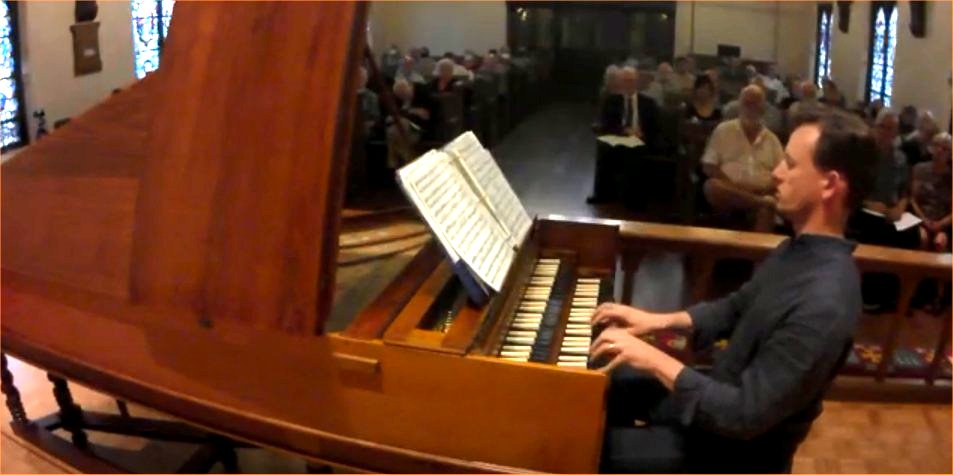
Opening with a set of three pieces by Byrd, played on a 17th-century Vaudry double-manual harpsichord by Owen Daly, Petrushansky displayed a command of varied touch and expression. My mind to me a kingdom is created a flowing, contemplative atmosphere in which harmonies merged one after the other. A Pavan and Galliard followed, the Pavan’s sweetly singing melody taking us on a leisurely journey involving some unexpected and refreshing diversions. The shorter, robust Galliard was performed with incisive chords and lively figurations. In the final piece of the set, variations on Will you walke the woods soe wylde, featuring drone basses with lively treble, as well as interesting variation contrasts, Petrushansky’s rhythmic and articulation energy propelled the composition forward, closing with explosive chords.
An English bentside spinet by Paul Irvin was used for the middle part of the program, which included compositions by Byrd, as well as antecedent and subsequent composers. An anonymous Felix Namque of an earlier time (c. 1530) provided some interesting contrasts. Late 17th-century John Roberts (c. 1650-80) showed some distance from Byrd’s generally contrapuntal lines; the mournful Almain featured beautifully expressive and flowing melodic lines, and his dancy Jigg also flowed nicely. According to the program, the spirited Corant may also have been by Roberts.
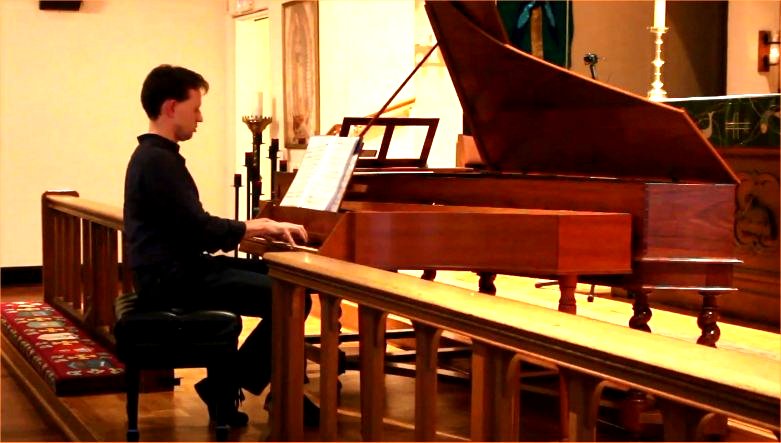
The middle portion also included two compositions by 20th-century composers. Herbert Howells’s (1892-1983) famous Lambert’s Fireside from his 1927 set of pieces, Lambert’s Clavichord, illustrated a continuing Renaissance legacy, recalling phrasing of the English virginalists. In Fireside, in a modern nod to Renaissance modality, Howells employs a scale of D-E-F#-G-A-Bb-C-D. As appropriate for a piece composed specifically for clavichord, the score shows nuanced markings of crescendo and decrescendo within piano and pianissimo levels. Petrushansky managed to convey similar nuance through minute timing adjustments.
The other 20th-century composition was a Sarabande by Lennox Berkeley (1903-1989), featuring traditional phrasing interspersed with unexpected, shocking modern harmonies. Toward the end, a dramatic pause on a single treble tone, followed by a quick descent into mysterious darkness, left one with an unsettled feeling.
Other Byrd pieces were particularly lovely: Qui Passe: for my Ladye Nevell, variations on a ground bass, and the contemplative If that a Sinner’s Sighs, with its beautiful, sustained tones and flowing phrases.
A younger contemporary of Byrd’s, Orlando Gibbons’ (1583-1625) Fantazia in Foure Parts, utilizing the spinet’s full range, displayed contrasting sections and Affekts, including lovely meditative melodic lines, and ringing, bell-like tones. With a typically more active rhythm toward the end, the piece came to a majestic conclusion.
Petrushansky returned to the double-manual Vaudry for the last section of the program, including Byrd’s monumental set of variations on Ut re mi fa sol la, a composition displaying the composer’s remarkable creative powers. Opening with an organ-like, contemplative four-part contrapuntal texture with long, sustained chords, Byrd introduces contrasting lively figures in the variations; toward the end, rapid toccata-like 8th notes build excitement, then noble majesty; the concluding contemplative expression brings the composition full circle.
A short, exciting anonymous piece, La Bonnette from The Mulliner Book, played with lively figuration and articulation, and a comical final phrase, produced a most enthusiastic response from the audience. A video of this recital is available on WEKA’s YouTube channel. – Watch
Review by Carol lei Breckenridge
About the Performer

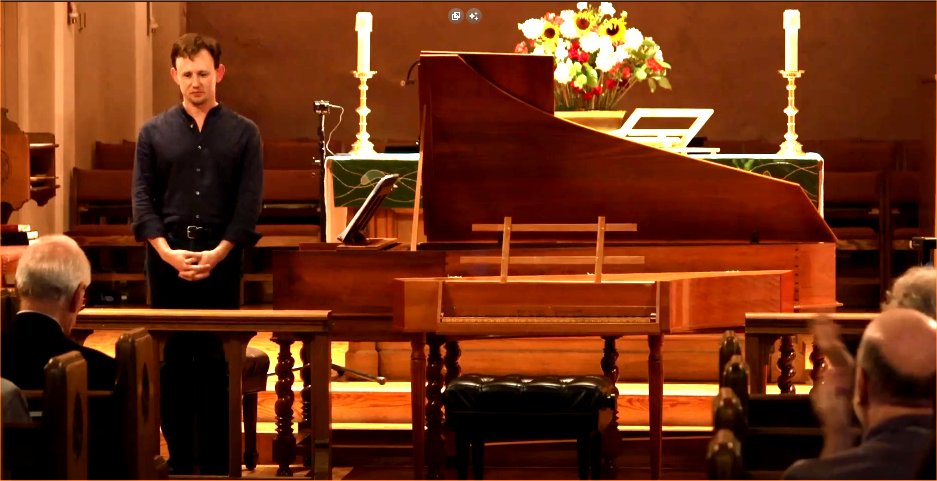
Eugene S. Petrushansky (born in Kazan, Tatarstan, Russia) studied harpsichord at the University of California with Davitt Moroney and Katherine Heater while pursuing a BS degree in Mechanical Engineering, with subsequent instruction in the form of masterclasses and private lessons with Arthur Haas, Alan Curtis, Jacques Ogg, James Johnstone, Bertrand Cuiller, and Ed Parmentier. Residing in Fremont, California, he has appeared around the San Francisco Bay Area in solo recitals and as continuo harpsichordist with professional ensembles. He serves as Organist at St Joseph of Arimathea Chapel in Berkeley and at St Francis of Assisi in Livermore and is a member of the board of directors for MusicSources. He also maintains an atelier for restoration of historical keyboard instruments.
General Admission $20 payable at the door
Free to 18 and under, and college students with ID